Is Your Email a PCI Compliance Risk?
July 9, 2026
Five Reasons You Need Business Email, Not Personal Email
Many small businesses use personal Gmail, Hotmail, and Yahoo email accounts for business purposes. Even when these email accounts were setup through the business, they are still classified as personal instead of business-class email accounts. Here is exactly why that puts your business at risk, and why business email is not optional if your business accepts credit cards.
#1 – Ransomware Can Shut Down Your Operations
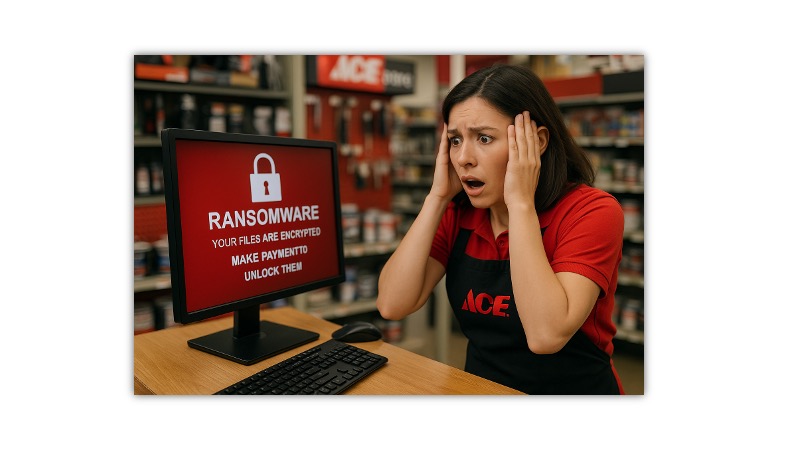
Personal email accounts do not include the malware filtering, threat scanning, or security controls that a business email platform provides. Once malicious software gets onto one computer, it can spread across your company’s network, including systems like your paint-mixing computer, not just your point-of-sale terminals. Small businesses are far from immune: 82 percent of 2021 ransomware attacks targeted companies with fewer than 1,000 employees, and recent studies put the average cost of a cyberattack on a small business at $25,000 to $35,000.
#2 – Fake Invoices and Financial Scams
One of the fastest-growing email scams involves a criminal impersonating a vendor, or even the store owner, to convince an employee to pay a fraudulent invoice or redirect a payment. This scam, known as business email compromise, has cost businesses more than $55 billion over the past decade. It works because personal email cannot enforce the technical safeguards that catch spoofed or look-alike vendor addresses. Business email can.
#3 – PCI Compliance
This is the one most owners do not know about. Personal email fails at least six specific requirements of the PCI Data Security Standard.
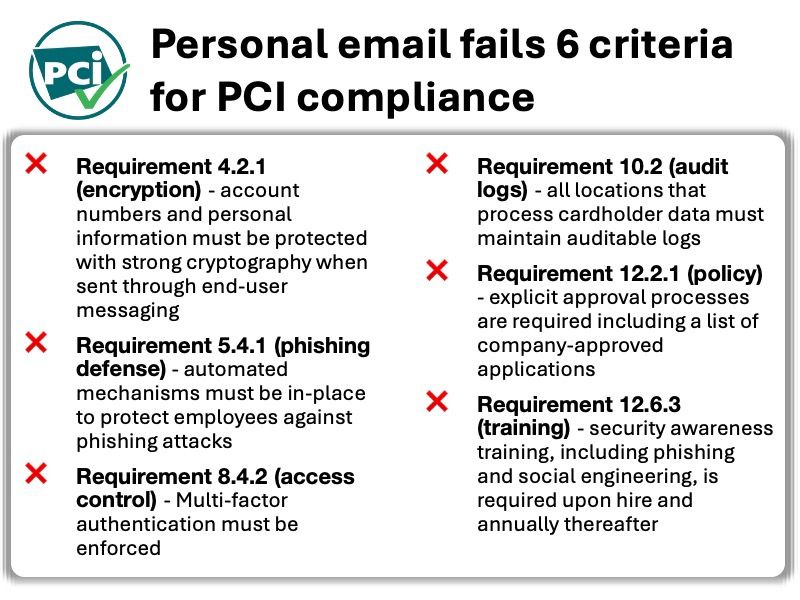
Personal email accounts like Gmail and Hotmail cannot enforce encryption, and many platforms don’t even support it. Automated phishing protection can only be implemented, configured, and enforced on a business email domain. MFA cannot be enforced across disparate email accounts. Audit logs are not available with personal email. Company policy cannot govern communications on a channel like personal email that the company does not fully control. Training consistency and phishing simulations cannot be implemented with personal email.
#4 – Protecting More Than Just Card Numbers
Your company’s email likely touches other sensitive information beyond credit cards: employee Social Security numbers for payroll, customer information tied to credit checks, and vendor account details. In fact, 87 percent of small businesses hold personally identifiable information (PII) that could be compromised in an attack. If that information is exposed, most states require you to notify everyone affected, regardless of whether cardholder data was involved. Personal email offers no encryption, no retention policy, and no access control to protect any of it.
#5 – Keeping Control of Your Business
If your business depends on personal email accounts for vendor orders, scheduling, or customer communication, your business does not actually control those accounts. There is no way to recover one if an employee leaves or forgets a password, and no way to shut off access the day someone is let go. It is widely reported, and commonly attributed to the National Cyber Security Alliance, that 60 percent of small businesses that suffer a serious cyberattack do not survive another year. A business that does not control its own email is at much greater risk.
What Should You Do?
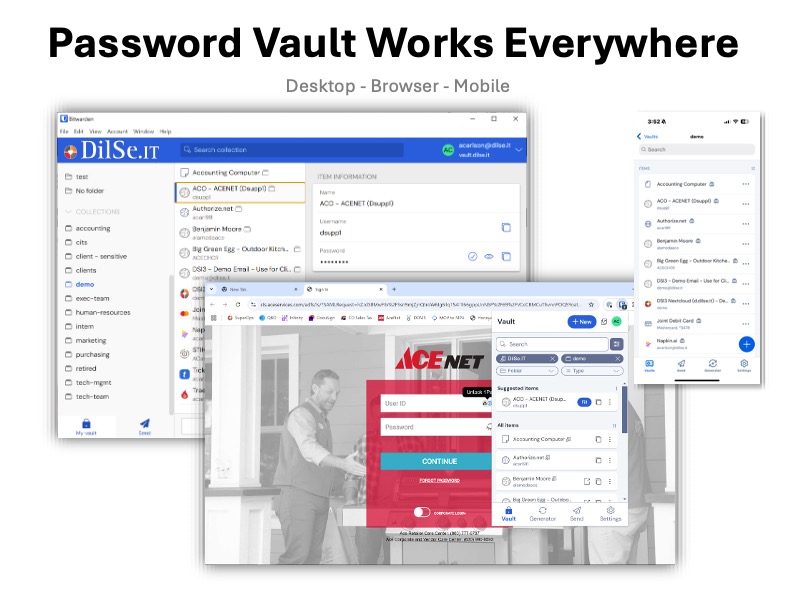
DilSe.IT’s RetailTech Business Services is purpose-built for Ace retailers and includes business email on your own branded domain (e.g., mainstreetace.com), fully PCI-compliant with encryption and secure archiving; secure cloud file storage with versioning for ransomware recovery; collaborative office apps fully compatible with Word, Excel, and PowerPoint; and a password vault to protect all credentials, payment cards, and sensitive business information. We handle everything from domain registration through user setup, data migration, Epicor integration, and training.
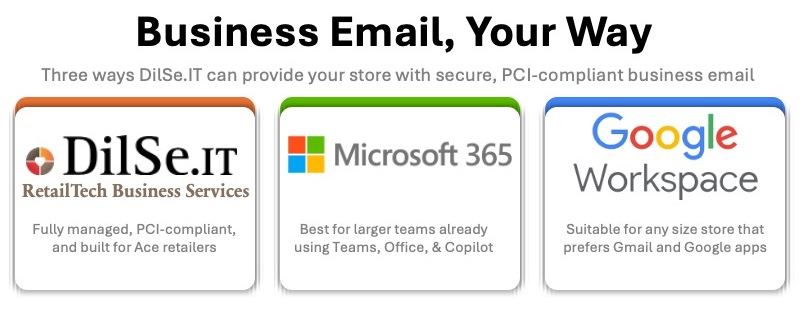
DilSe.IT can also provide business email through Microsoft 365 or Google Workspace if you would rather use one of those platforms. Microsoft 365 costs more, but it is often the right fit for larger organizations already invested in Microsoft tools like Teams, Office, and Copilot AI. Google Workspace works well for businesses of any size, particularly those who prefer the Gmail interface and Google’s suite of apps.
To request more information on business email for your company, visit our Contact Page.